In depth: profile
Mihajlo Pupin
From the Banat to a Columbia chair, the loading coil and a Pulitzer. A bridge bears his name.

Photo Credit
Image courtesy of © Ajay Suresh from New York, NY, USA · CC BY 2.0 via Wikimedia CommonsMihajlo Pupin left the Banat village of Idvor for America in 1874 and became a professor at Columbia University, the inventor of the loading coil that carried telephone calls across a continent, and the author of a Pulitzer Prize–winning autobiography. Belgrade remembers him in a bridge over the Danube and in the institute that bears his name.
A birthday nobody agrees on
Even the start is a puzzle. Mihajlo Pupin was born in Idvor, a village in the Banat, but the records give two different years. Pupin himself blamed a priest’s slip of the pen on the certificate he needed for his wedding in 1888. We print neither year, which seems the proper way to treat contradictory data in the life of a physicist.
He grew up among farmers on the edge of the old Military Frontier, and in 1874 he crossed the Atlantic with next to nothing in his pockets. America was not a soft landing. He worked his way up, learned the language, and in 1883 graduated from Columbia College in New York.

Photo Credit
Image courtesy of © Bain · Public domain via Wikimedia CommonsBerlin and back
He went on to Berlin and took his doctorate in 1889 under Hermann von Helmholtz, one of the giants of nineteenth-century physics, then returned to Columbia to teach. He stayed for the rest of his career, and the university’s physics building, Pupin Hall, now a US National Historic Landmark, carries his name.
Early in 1896, within weeks of the news of Röntgen’s new rays, Pupin made some of the earliest X-ray photographs in America, using a fluorescent screen to cut exposure times dramatically. Medicine took note.
The coil that shrank a continent
His great invention was quieter, and worth far more. Telephone calls faded over long lines: past a certain distance, a voice dissolved into mush. Pupin worked out the mathematics of the problem and showed that coils placed at measured intervals along the line would carry speech much further. He patented the loading coil in 1900, and in 1901 the rights were sold to AT&T.
The Pupin coil made long-distance telephone lines practical and made its inventor rich. Long-distance calls stopped sounding like conversations shouted down a well, and a voice in New York could be heard, clearly, a very long way west.
A teacher of inventors
Pupin was a gifted teacher. Robert Millikan, later a Nobel laureate, studied under him at Columbia, and Edwin Howard Armstrong, the inventor of FM radio, was his student and assistant. He was a founding member of the National Advisory Committee for Aeronautics in 1915, the forerunner of NASA, and president of the American Institute of Electrical Engineers in 1925 and 1926.
He landed in America with next to nothing and left it a professor, an inventor and a Pulitzer Prize winner. The certificate of his own birth was the one document he could never get right.
The Pulitzer Prize
In 1923 he published his life story, From Immigrant to Inventor, and in 1924 it won the Pulitzer Prize for Biography. It is one of the founding texts of the American immigrant dream, written by a man who never stopped thinking of himself as a boy from Idvor.
He died in New York on 12 March 1935. In Belgrade the Mihajlo Pupin Institute, founded in 1946, has carried his name into computing and electronics, and since December 2014 Pupin Bridge has carried traffic across the Danube between Zemun and Borča. It is a fitting memorial for a man who spent his career making connections across great distances.
Our advice: see Pupin Bridge from the water on a Danube cruise from Zemun, or from the Gardoš Tower, and borrow From Immigrant to Inventor before you travel: it is still a gripping read.
Why it's on our list
- Loading coil, patented 1900
- Pulitzer Prize for Biography, 1924
- Professor at Columbia University
- Pupin Bridge and the Mihajlo Pupin Institute in Belgrade
More in depth
 The back storySerbian CuisineĆevapi, sarma, gibanica, kajmak and proja: the dishes of Serbia and where to taste them.
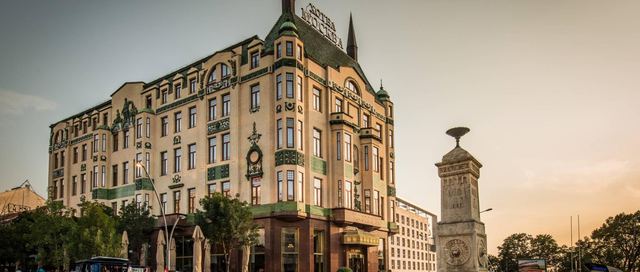 The back storyFrom the džezva to the flat white: Belgrade’s café culture, the back storyFive centuries of coffee in Belgrade: the first coffee house, the Moskva, the new roasters.
 The back storyRakija, riddles and a question mark: how Belgrade drinks, the back storyFrom the oldest kafana and Skadarlija to UNESCO-listed šljivovica and the cocktail courtyards.