In depth: profile
Mileva Marić
A pioneer in physics, she studied with Einstein in Zurich and married him. The debate goes on.

Photo Credit
Image courtesy of © Leonhard Lenz · CC0 via Wikimedia CommonsMileva Marić was one of the first women to study physics at the Zurich Polytechnic, where she met a fellow student called Albert Einstein. They married in 1903 and had three children. How much she contributed to his early work is still debated. Her story begins in Titel, in Vojvodina.
A girl in the boys’ school
Mileva Marić was born on 19 December 1875 in Titel, a small town in Vojvodina on the Tisa, close to where it meets the Danube. She was clever, and her father backed her schooling. In 1892 she was given special permission to attend physics lectures at the Royal Classical Gymnasium in Zagreb, a school for boys.

Photo Credit
Image courtesy of © Unknown author · Public domain via Wikimedia CommonsAt the time this was close to unheard of. Universities across much of Europe still kept women out, and those that let them in usually steered them away from mathematics and physics.
Zurich, 1896
In 1896 she enrolled at the Zurich Polytechnic, today’s ETH Zurich, in the section that trained teachers of mathematics and physics. She was the only woman in her year, and only the fifth woman ever admitted to that section. One of her fellow students was a young man from Ulm called Albert Einstein.
They studied together, fell in love and wrote to each other constantly when apart. The letters, published in 1992, are funny, tender and full of physics. In them Einstein more than once writes of “our work”.
A family
Their daughter, Lieserl, was born early in 1902; what became of her is not known. Mileva and Albert married in Bern on 6 January 1903, while he worked at the patent office. Their sons followed: Hans Albert in 1904, who became a professor of hydraulic engineering, and Eduard in 1910.
The marriage did not survive Einstein’s fame. They separated in 1914 and divorced on 14 February 1919. The settlement assigned to Mileva the money from a Nobel Prize that Einstein had not yet won. He won it two years later, which suggests that both of them had a fair idea of the size of his talent.
The letters speak of “our work”. More than a century later, the phrase still has historians arguing.
The question that will not go away
Did she help with the great papers of 1905? The debate is real and has been running for decades. Most historians of physics see no evidence that she made a substantive contribution to the theory of relativity; others read the letters as proof of a working partnership. Nothing found so far settles it.
What is beyond dispute is the obstacle course she ran to get to Zurich at all, and what it cost her. Which raises the question worth leaving the reader with: how many other Milevas were never let into the lecture hall?
She spent the rest of her life in Zurich, giving lessons and caring for Eduard, who was seriously ill, and died there on 4 August 1948.
Our advice: read the published letters between Mileva and Albert before you make up your mind; they are the closest thing to evidence either side has.
Why it's on our list
- Born in Titel, 1875
- Studied physics at the Zurich Polytechnic from 1896
- Married Albert Einstein in 1903
- Her divorce settlement assigned her his Nobel Prize money
More in depth
 The back storySerbian CuisineĆevapi, sarma, gibanica, kajmak and proja: the dishes of Serbia and where to taste them.
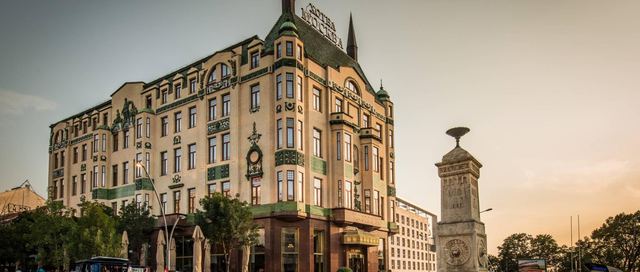 The back storyFrom the džezva to the flat white: Belgrade’s café culture, the back storyFive centuries of coffee in Belgrade: the first coffee house, the Moskva, the new roasters.
 The back storyRakija, riddles and a question mark: how Belgrade drinks, the back storyFrom the oldest kafana and Skadarlija to UNESCO-listed šljivovica and the cocktail courtyards.