In depth: profile
Nikola Tesla
The inventor of the AC motor visited Belgrade once, for 31 hours. His ashes and archive stayed.

Photo Credit
Image courtesy of © Rburg87 · CC BY-SA 3.0 via Wikimedia CommonsNikola Tesla gave the world the alternating-current motor and the polyphase system that still carries power into homes around the world. Born in Smiljan in 1856 to a Serbian Orthodox priest, he made his name in New York and visited Belgrade only once, in 1892. His ashes and his archive now rest in the museum that bears his name.
The priest’s son from Lika
Nikola Tesla was born on 10 July 1856 in Smiljan, a village in Lika, where his father, Milutin, was a Serbian Orthodox priest. He studied at the Polytechnic in Graz, left without a degree, and went to work: at the telephone exchange in Budapest in 1881, then for Continental Edison in Paris. In June 1884 he landed in New York and worked, briefly and unhappily, for Thomas Edison himself.

Photo Credit
Image courtesy of © Napoleon Sarony · Public domain via Wikimedia CommonsThe two men could hardly have been less alike. Edison was a tinkerer who tried a thousand filaments to find one that worked; Tesla claimed he could build a machine in his head, run it, and find the faults before he touched a tool. Edison backed direct current. Tesla had already worked out the rotating magnetic field that would make alternating current practical.
The current that won
His patents for the alternating-current induction motor were granted on 1 May 1888, and that July George Westinghouse took a licence. The so-called war of the currents followed. In 1893 Westinghouse’s alternating current lit the World’s Columbian Exposition in Chicago, and on 16 November 1896 power from the Adams station at Niagara Falls reached Buffalo on Tesla’s polyphase system.

Photo Credit
Image courtesy of © Unknown photographer · Public domain via Wikimedia CommonsThat was the argument settled, and it has been settled again every time a plug has met a socket since. Most of the electricity in the world still travels as alternating current, generated, sent and used in ways Tesla would recognise.
The showman of the laboratory
Tesla understood theatre as well as physics. He drew artificial lightning from his coils, and in 1898, at the Electrical Exhibition in Madison Square Garden, he steered a small boat around a tank of water by radio, years before most of his audience had heard the word. On Long Island he began Wardenclyffe Tower, his great experiment in sending power without wires. It was never finished, and it was demolished in 1917.
His later years were spent in hotels, with pigeons and patents for company. He died on 7 January 1943 at the Hotel New Yorker in Manhattan. In 1960 the international unit of magnetic flux density was named the tesla; few inventors become a unit of measurement, and fewer still go on to lend their name to a car company as well.
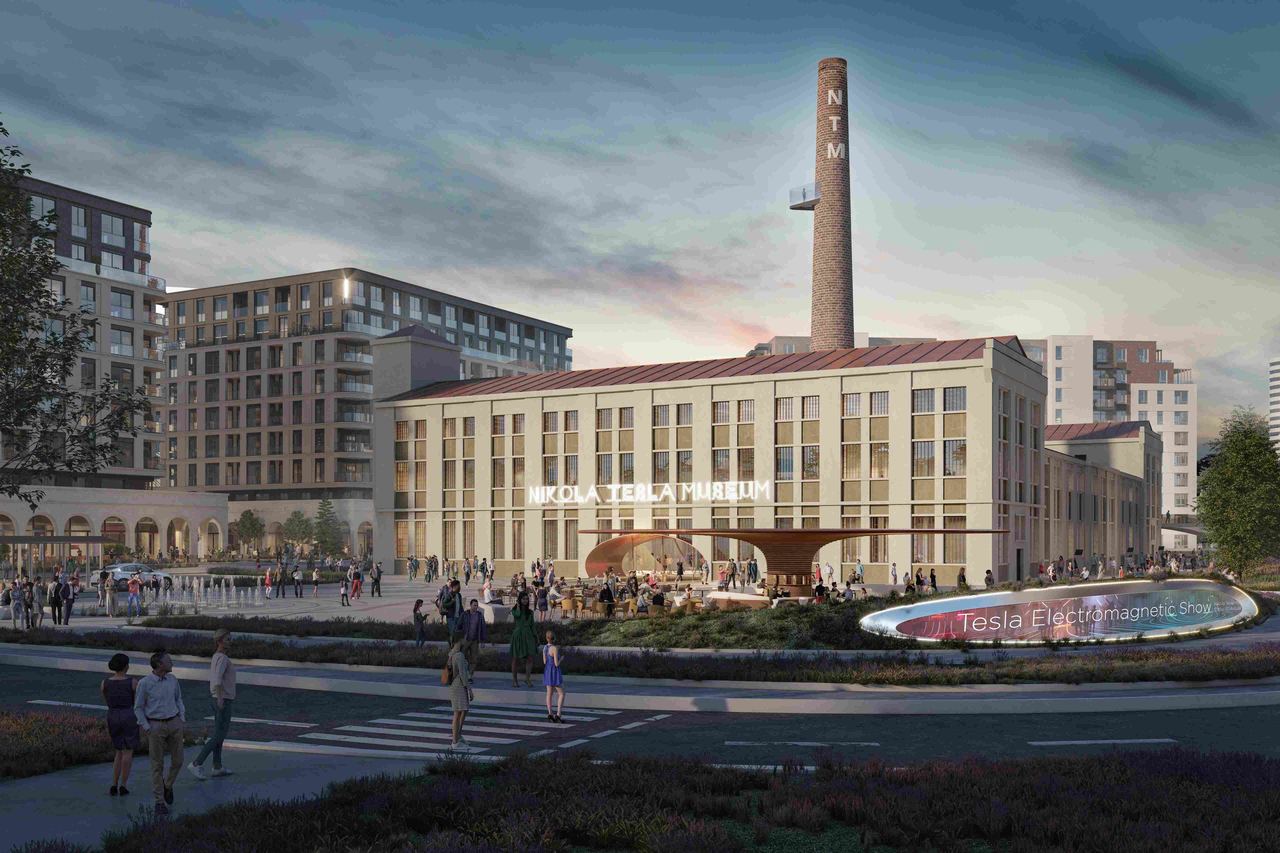
Photo Credit
Image courtesy of © Belgrade Waterfront / Zaha Hadid ArchitectsThirty-one hours in Belgrade
Tesla came to Belgrade once. He arrived on 1 June 1892 (20 May by the old calendar then used in Serbia), and, by the museum’s own count, stayed for 31 hours. It was a whirlwind of receptions, speeches and well-wishers, and he never came back in his lifetime.
He spent 31 hours in Belgrade in his lifetime. The city has spent the decades since making up for it.
Belgrade has been making up for it ever since. The airport carries his name, he appears on the 100-dinar note, his monument stands in front of the Technical Faculties, and the Nikola Tesla Museum, founded on 5 December 1952, holds his personal archive, which was inscribed on UNESCO’s Memory of the World register in 2003.
The golden sphere
The museum opened to the public on 20 October 1955 in a villa on Krunska Street designed by the architect Dragiša Brašovan. Since 1957 Tesla’s ashes have rested there, in a golden sphere that sits in its own quiet room, which makes the museum a place of pilgrimage as much as a collection. Guided tours include live demonstrations of his inventions, crackling sparks and all.
The next chapter is already drawn. The museum is to move to the Milan Vapa paper mill of 1924, redesigned by Zaha Hadid Architects, on the edge of Belgrade Waterfront. It raises a question the city will answer for a generation: how do you build a shrine to a man whose great idea was to make power invisible?
Our advice: book a guided tour of the museum on Krunska Street, ideally on a weekday morning, and leave time afterwards for the quiet room with the sphere. Then read the museum’s own long story of his life on our page.
Why it's on our list
- AC induction motor, patented 1888
- Niagara Falls power reached Buffalo in 1896
- His ashes and archive are in Belgrade
- UNESCO Memory of the World, 2003
More in depth
 The back storySerbian CuisineĆevapi, sarma, gibanica, kajmak and proja: the dishes of Serbia and where to taste them.
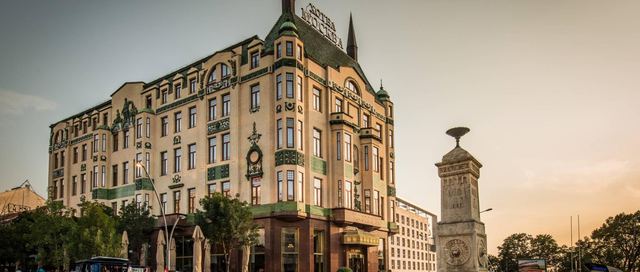 The back storyFrom the džezva to the flat white: Belgrade’s café culture, the back storyFive centuries of coffee in Belgrade: the first coffee house, the Moskva, the new roasters.
 The back storyRakija, riddles and a question mark: how Belgrade drinks, the back storyFrom the oldest kafana and Skadarlija to UNESCO-listed šljivovica and the cocktail courtyards.