In depth: profile
Mihailo Petrović Alas
Mathematician, master fisherman, musician and polar voyager: the professor Belgrade called Alas.

Photo Credit
Image courtesy of © Fred Romero from Paris, France · CC BY 2.0 via Wikimedia CommonsMihailo Petrović took a doctorate in Paris and a master fisherman’s certificate in Belgrade, a year apart, and never chose between them. He founded Serbia’s school of mathematics, built a machine that solved equations with water, played in his own ensemble and sailed from Greenland to the Antarctic. Belgrade still calls him Alas, the river fisherman.
Two certificates
Mihailo Petrović was born in Belgrade on 6 May 1868, went to the First Belgrade Gymnasium and the Great School, and in 1890 entered the École Normale Supérieure in Paris. On 21 June 1894 he defended his doctorate before a jury of Charles Hermite, Émile Picard and Paul Painlevé, three of the great names of French mathematics.
He had another apprenticeship running at the same time. He was an apprentice river fisherman at fourteen, a journeyman in 1888 and, in 1895, passed his master fisherman’s exam. That is where the nickname comes from: an alas is a fisherman of the Sava and the Danube. Few men have held both certificates; fewer still were proud of the second one in quite the same way.

Photo Credit
Image courtesy of © Uroš Predić · Public domain via Wikimedia CommonsThe school he built
Back in Belgrade he won his professorship at the Great School in 1894, by a single vote. It turned out to be one of the more consequential votes in Serbian science. For almost three decades, from 1912 to 1941, he was the only supervisor of doctorates in mathematics in Belgrade, and a whole generation of Serbian mathematicians passed through his hands.
He wrote more than 300 papers, took part in five International Congresses of Mathematicians between 1900 and 1924, and became a full member of the Academy in 1899, at the age of thirty-one.
Solving equations with water
In 1897 he described, in the Comptes rendus of the French Academy of Sciences, a hydro-integrator: a machine that used flowing water to solve equations. It won a gold medal at the World Exhibition in Paris in 1900. It is often called the first analogue computer; that is a claim too far, but it was an ingenious answer to a hard problem, made by a man who knew more about how water moves than most mathematicians alive.
Fishing, music and codes
He took river fishing as seriously as differential equations. He helped draft Serbia’s first freshwater fishing law in 1898, won a gold medal for his fishing exhibits in Turin in 1911, and in 1912 landed a catfish weighing 120 kilograms. In January 1896 he founded a music ensemble, Suz, which collected more than 700 melodies.
In 1894 he defended a doctorate before the greatest mathematicians in Paris. In 1895 he passed his master fisherman’s exam on the Sava. Belgrade has never quite decided which made him more famous.
He was also, for years, the army’s chief cryptographer; his records fill fifteen volumes. A man who could break a code, play a tune and gut a catfish was not a man people forgot.
To the ends of the earth
In his sixties he started travelling the oceans: Greenland in 1931, the Sargasso Sea, the Caribbean and Bermuda in 1932, Labrador and Newfoundland in 1933, the Antarctic in 1934, the Indian Ocean in 1935 and the Azores in 1939. A Belgrade river fisherman had become, in effect, a polar explorer.
The war caught up with him in 1941. At seventy-three he put on a lieutenant colonel’s uniform and was taken prisoner. He died at home in Belgrade on 8 June 1943, and the fishermen of the city carried his coffin to the Cathedral Church.
The house on Kosančićev venac
His house at Kosančićev venac 22, built in 1910 to a design by the architect Petar Bajalović, has been a protected cultural monument since 1966. It stands on one of the oldest streets in Belgrade, on the slope above the Sava, which is exactly where a mathematician who loved the river would choose to live.
Our advice: walk the cobbles of Kosančićev venac in the late afternoon, past the house of Alas, then go down to the Sava and watch the fishermen on the banks: his heirs, in their own way.
Why it's on our list
- Doctorate in Paris, 1894
- Master river fisherman, 1895
- Gold medal for his hydro-integrator, Paris 1900
- His house on Kosančićev venac
More in depth
 The back storySerbian CuisineĆevapi, sarma, gibanica, kajmak and proja: the dishes of Serbia and where to taste them.
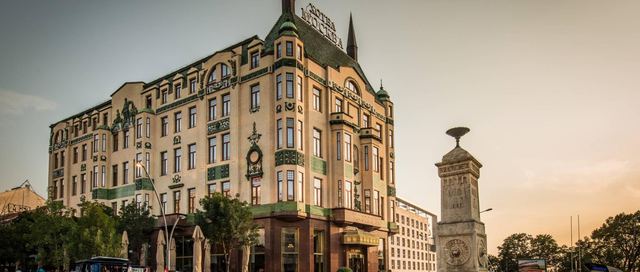 The back storyFrom the džezva to the flat white: Belgrade’s café culture, the back storyFive centuries of coffee in Belgrade: the first coffee house, the Moskva, the new roasters.
 The back storyRakija, riddles and a question mark: how Belgrade drinks, the back storyFrom the oldest kafana and Skadarlija to UNESCO-listed šljivovica and the cocktail courtyards.