In depth: profile
Desanka Maksimović
The poet of love, landscape and the children of Kragujevac, taught and loved for seven decades.

Photo Credit
Image courtesy of © BrankaVV · CC BY-SA 4.0 via Wikimedia CommonsDesanka Maksimović was one of the best-loved Serbian poets of the twentieth century: a poet of love and landscape who wrote her best-known poem, “A Bloody Fairy Tale”, about the schoolchildren shot in Kragujevac in October 1941. She taught in Belgrade, became a full member of the Serbian Academy of Sciences and Arts and is buried in Brankovina, the village where she grew up.
A village near Valjevo
Desanka Maksimović was born on 16 May 1898 in Rabrovica, near Valjevo, and grew up in Brankovina, a village of orchards and wooded hills in western Serbia. The landscape never left her poetry: meadows, rivers, the first frost and the first love keep coming back, set down with a clarity that makes them look easy.

Photo Credit
Image courtesy of © Ljubivoje Ršumović · CC BY-SA 4.0 via Wikimedia CommonsShe studied at the Faculty of Philosophy of the University of Belgrade and taught for years at the First Belgrade Girls’ Gymnasium. Generations of Belgrade girls learned literature from a woman who was busy writing it.
The poet of first love
Her early love poems, among them “Strepnja” (“Apprehension”), made her famous. They are short, musical and painfully exact about the moment before something begins, which may be why so many Serbs still know them by heart. Love poetry ages badly when it is sentimental. Hers has lasted because it is precise.
A bloody fairy tale
In October 1941 German occupying forces in Kragujevac shot thousands of civilians in reprisal for attacks on their troops. Among them were schoolboys taken from their classrooms with their teachers. It is one of the darkest days in Serbian history.
Desanka Maksimović answered it with “Krvava bajka” (“A Bloody Fairy Tale”), which begins like a children’s story and ends with a whole class of pupils dying on the same day. It is her best-known poem, and it does what history books cannot: it makes the reader count the empty desks.
Asking for mercy
In 1964 she published “Tražim pomilovanje” (“I Seek Mercy”), a cycle of poems written as a dialogue with the medieval law code of Tsar Dušan. Article by article, she pleads for the people the code punishes: the poor, the outcasts, the ones who broke the rules for love or hunger. It is a grown-up book of compassion, and many readers think it her best.
A poet of first love and green hills, she wrote the poem a whole country learned to recite through tears.
The Serbian Academy of Sciences and Arts elected her a corresponding member in 1959 and a full member in 1965. For her inaugural address on 28 April 1966 she did not give a lecture: she read three poems from “Tražim pomilovanje”. It must be one of the few academic inaugurations ever remembered for its brevity.
Home to Brankovina
She died in Belgrade on 11 February 1993, at the age of 94, and was buried in the churchyard at Brankovina. In Belgrade a seated bronze of her rests in Tašmajdan Park, a short walk from the playgrounds: a fitting place for a teacher.
Our advice: Brankovina, near Valjevo, makes a fine day out from Belgrade. Visit the church and her grave, then walk the hills that fill her poems.
Why it's on our list
- Born near Valjevo, 1898
- “Krvava bajka”, written after October 1941
- Full member of the Serbian Academy from 1965
- Buried in Brankovina
More in depth
 The back storySerbian CuisineĆevapi, sarma, gibanica, kajmak and proja: the dishes of Serbia and where to taste them.
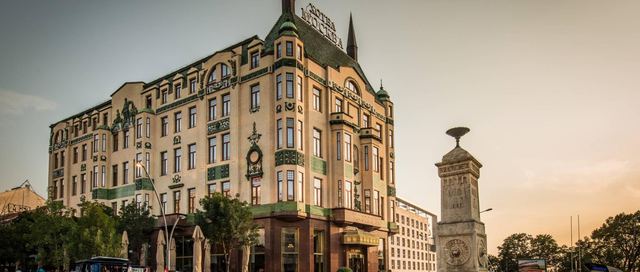 The back storyFrom the džezva to the flat white: Belgrade’s café culture, the back storyFive centuries of coffee in Belgrade: the first coffee house, the Moskva, the new roasters.
 The back storyRakija, riddles and a question mark: how Belgrade drinks, the back storyFrom the oldest kafana and Skadarlija to UNESCO-listed šljivovica and the cocktail courtyards.