In depth: profile
Ivo Andrić
The Nobel laureate of The Bridge on the Drina, whose Belgrade flat is now a museum.

Photo Credit
Image courtesy of © Mickey Mystique · CC BY-SA 4.0 via Wikimedia CommonsIvo Andrić won the Nobel Prize in Literature in 1961, and is best known for The Bridge on the Drina and the novels around it, books that turn the history of the Balkans into human stories. He made his home in Belgrade, and from 1958 lived in the flat on the little square now named after him, which is today his memorial museum.
A boy from Bosnia
Ivo Andrić was born in October 1892 in Dolac, near Travnik, in Bosnia. He studied in Zagreb, Vienna and Kraków, took his doctorate in Graz in 1924, and spent much of his working life as a diplomat in the capitals of Europe, writing all the while.
The bridge
His masterpiece, The Bridge on the Drina, tells four centuries of life in the town of Višegrad through the stone bridge that spans its river, built in the sixteenth century by the Grand Vizier Mehmed Pasha Sokolović. Generations come and go, empires rise and fall, the bridge stays. It is a novel with a building for its hero, and it works.
It belongs to a group of novels he published in 1945, with Travnik Chronicle and The Woman from Sarajevo. Together they made him the great chronicler of Bosnia and its many peoples, and they are still the best introduction a reader can have to the Balkans.
Stockholm, 1961
In 1961 the Swedish Academy awarded him the Nobel Prize in Literature “for the epic force with which he has traced themes and depicted human destinies drawn from the history of his country”.
He did not keep the money. He gave the prize to a fund for the libraries of Bosnia and Herzegovina, paid in two instalments in 1962 and 1965. Few gestures by a laureate have aged as well.
The flat on the square
From 1958 Andrić lived with his wife, the costume designer Milica Babić, in a flat in the centre of Belgrade. He died in Belgrade on 13 March 1975. The following year the flat opened as the Memorial Museum of Ivo Andrić, run by the Belgrade City Museum, and the little square outside now carries his name: Andrićev venac.
He gave away the whole Nobel purse to libraries. For a writer who believed in bridges, books were the obvious place to spend it.
The rooms are kept as he left them: his desk, his books, his pictures and the view he wrote by. It is one of the most intimate museums in the city, and a reminder that great books are often written in quite ordinary rooms.

Photo Credit
Image courtesy of © Venlur · CC BY-SA 4.0 via Wikimedia CommonsOur advice: visit the museum, then sit on a bench on Andrićev venac, beside his monument. Read the first chapter of The Bridge on the Drina there; you will want to finish it.
Why it's on our list
- Nobel Prize in Literature, 1961
- The Bridge on the Drina
- Gave his prize money to libraries
- His flat on Andrićev venac is a museum
More in depth
 The back storySerbian CuisineĆevapi, sarma, gibanica, kajmak and proja: the dishes of Serbia and where to taste them.
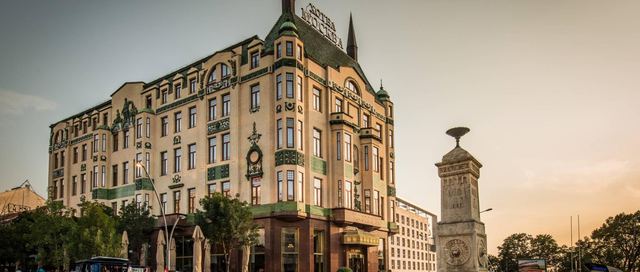 The back storyFrom the džezva to the flat white: Belgrade’s café culture, the back storyFive centuries of coffee in Belgrade: the first coffee house, the Moskva, the new roasters.
 The back storyRakija, riddles and a question mark: how Belgrade drinks, the back storyFrom the oldest kafana and Skadarlija to UNESCO-listed šljivovica and the cocktail courtyards.