Science
Tesla in New York: the hotel rooms, the pigeons and the tower on Long Island
From Smiljan to Room 3327: Tesla’s American life, a white pigeon and the tower on Long Island.

Photo Credit
Image courtesy of © Ermell · CC BY-SA 4.0 via Wikimedia CommonsHe stepped ashore in Manhattan with four cents and a book of his own poems, and he left it a legend who had long outlived his money. This is Nikola Tesla’s American life: the priest’s son from Smiljan, the dinners alone at Delmonico’s, the tower on Long Island that was meant to send power around the globe, and the last ten years in a hotel high above Eighth Avenue, where the pigeons knew the window.
The priest’s son
Before New York there was Smiljan, a village in Lika where Nikola Tesla was born in July 1856. His father, Milutin, was a Serbian Orthodox priest; his mother was Đuka Mandić. He grew up on the Orthodox calendar and Serbian epic verse, and he carried both across the Atlantic, the way other emigrants carry a photograph.
The rest of the early story, Graz, Budapest and Paris, is in our profile. This is the American half: nearly sixty years in which he lit the world, lost a fortune and ended up talking to birds.
Four cents and a book of poems
When Tesla stepped out of the immigration office at Castle Garden in the summer of 1884, according to his first biographer, John J. O’Neill, he owned four cents, a book of his own poems, a couple of technical articles, calculations for a flying machine and a letter of introduction to Thomas Edison.

Photo Credit
Image courtesy of © Napoleon Sarony · Public domain via Wikimedia CommonsWalking to find a friend, he passed a shop where a man was about to give up on a broken electrical machine. Tesla mended it, refused payment, and was pressed to take twenty dollars anyway. As first days in America go, it beats most immigration stories and nearly every business plan.
The dandy who dined alone
Success made him a fixture of Manhattan’s smartest rooms. He dined nightly at Delmonico’s, and later at the Waldorf-Astoria, at tables kept for him and placed out of view, because he disliked being stared at, and he always dined alone.
O’Neill records the rest of the ritual: a fresh tablecloth at every meal, a stack of two dozen napkins at his left hand, and every dish and fork polished again before use, each napkin dropped to the floor in turn. It was hygiene raised to the level of performance art.
The tower at Wardenclyffe
In 1901, with funding from the financier J. P. Morgan, Tesla began building at Wardenclyffe, near Shoreham on the north shore of Long Island. Stanford White designed the red-brick laboratory, and beside it rose a 187-foot wooden tower. Its purpose was nothing less than a system to transmit energy and information around the globe, without wires.

Photo Credit
Image courtesy of © Unknown photographer · Public domain via Wikimedia CommonsMorgan, the Tesla Science Center says, grew sceptical of the commercial viability of wireless power, and the money stopped. By 1906 the project had effectively ended, and in 1917 the unfinished tower was demolished for scrap to satisfy Tesla’s debts. The dream of power through the air ended as metal sold by the ton.
Wardenclyffe today
The laboratory survived. It is the only Tesla laboratory still standing, and its 1901 structure even came through a fire on 21 November 2023. In August 2012 the cartoonist Matt Inman, of The Oatmeal, launched an online appeal that raised $1.37 million from more than 33,000 donors, and New York State pledged a matching grant of $850,000.
In May 2013 the Tesla Science Center at Wardenclyffe bought the site, and in 2018 it was listed on the National and New York State Registers of Historic Places. A statue of Tesla, inscribed “Serbian and American”, stands outside, and every July, around his birthday, the centre holds a Nikola Tesla Expo.

Photo Credit
Image courtesy of © Margaret57WC · CC BY-SA 4.0 via Wikimedia CommonsThe centre describes the full site as still in development. Its Sayan Visitor Center is planned for late 2026, and its 2026 season of guided exterior tours ran from 20 March to 15 November; check the centre’s website for the next season and an opening date.
He was found on the plaza of the Public Library, wearing a crown of two pigeons, while the engineers of America waited for him in evening dress.
The pigeons
In 1917 the American Institute of Electrical Engineers awarded Tesla its Edison Medal, an honour he was in no hurry to accept, given whose name was on it. On the evening of the ceremony he vanished from the dinner. The committee chairman, B. A. Behrend, found him on the plaza of the New York Public Library, wearing, in O’Neill’s words, a crown of two pigeons on his head, with a dozen more on his arms and hundreds at his feet.
Feeding them was a nightly pilgrimage, to the Library and St Patrick’s Cathedral. It also cost him homes: one hotel, O’Neill writes, gave him the choice of ceasing to feed the pigeons or leaving. He left. The Hotel Pennsylvania and the Governor Clinton went the same way, over bills and birds.
The hotel years
In 1933 he moved into his last address, the Hotel New Yorker on Eighth Avenue, the Art Deco tower with the red sign on its roof. The hotel says he stayed in rooms 3327 and 3328 for ten years, until his death there on 7 January 1943, aged 86. In the autumn of 1937, walking out after midnight to feed his pigeons, he was struck by a taxi a couple of blocks from the hotel.
The birthdays kept coming. TIME put him on its cover on 20 July 1931 for his 75th, and at his birthday dinner of 1938, at the New Yorker, he spoke of interplanetary communication. Nobody, it seems, had the heart to ask for details.
The white pigeon
One bird mattered more than the rest: a white female with grey-tipped wings. He told O’Neill, “I loved that pigeon, I loved her as a man loves a woman, and she loved me.” When she fell ill he nursed her back to health; when she died, he said, a dazzling light came from her eyes, and “something went out of my life.”
Take it as you will: grief, poetry or the loneliness of a very long life. It is still a very human sentence from a man whose name is now a unit of magnetic flux density.
In his own words
In 1919 Tesla told his own story, in six instalments of Electrical Experimenter magazine published from February to June and in October, later collected as the book My Inventions. It is short, strange and worth an evening; he describes inventing in his head with the calm of a man reading a timetable.
Becoming Tesla’s ambassador
The New Yorker never quite let him go, and neither has Belgrade’s art. The painter Jelena Bibić, known as Jeka, holds the title of Tesla Ambassador for Serbia. She received the Tesla Science Foundation award at the New Yorker Hotel during the foundation’s annual Tesla Spirit conference, and her site records her art on permanent display at the New Yorker Museum in Manhattan.
One of her portraits puts him back where he lived: the red neon of the New Yorker sign on one side, the Wardenclyffe tower on the other, and Tesla between them in electric blue, among chalk-white ghosts of coils, bulbs and motors, with veins of lightning running behind him like cracks in the night.
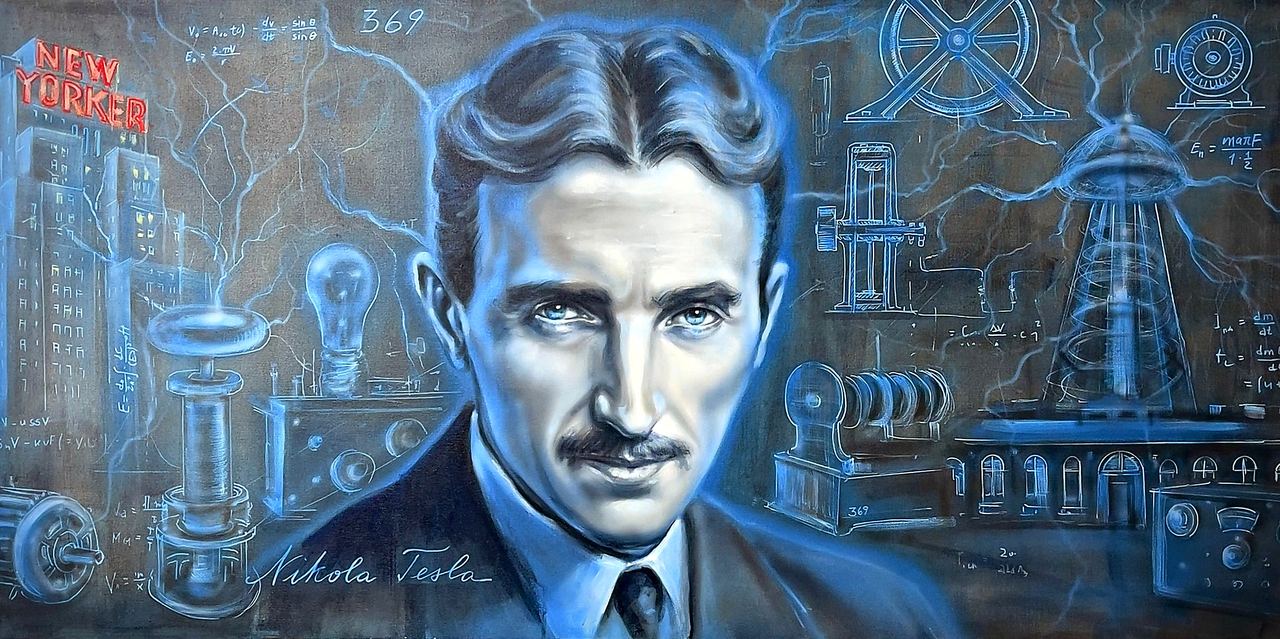
Photo Credit
Image courtesy of © Jelena BibićIn her own words: “As a youngster, I was introduced to the brilliant mind of Nikola Tesla and until now, I have taken on the unofficial role of ambassador by highlighting his work to anyone interested in listening.”
And: “His work has been my source of inspiration and admiration, prompting me to delve into extensive research, collecting every book that documents his altruistic pursuits for the betterment of humanity, rather than personal gain.”
Where to find Tesla’s New York
Our advice: start at the Hotel New Yorker on Eighth Avenue, then walk to Bryant Park and the steps of the New York Public Library, where he fed his pigeons. For Wardenclyffe, drive out to Shoreham and book an exterior tour in season. And in Belgrade, finish where he rests: the Nikola Tesla Museum on Krunska Street keeps his archive and his ashes.
Why it's on our list
- The priest’s son from Smiljan
- Four cents and a book of poems
- The tower at Wardenclyffe
- Wardenclyffe today
- The hotel years
- The white pigeon
- Jelena Bibić, Tesla Ambassador
Location
The map comes from Google Maps, which sets its own cookies once it loads.
More in depth
 ScienceAI in space: the machines that land, steer and exploreSelf-landing rockets, Starship, Artemis and the AI driving Perseverance: space exploration in 2026.
 SpaceHubble, Webb and the great telescopesFrom Hubble’s flawed mirror to Webb, Roman, Rubin and the ELT: how telescopes changed our place.
 SpaceLook up: the great observatories, planetariums and science museumsObservatories, planetariums and space galleries from London to Maunakea, and how to visit them.